Sulette van Der Merwe South African, b. 1982
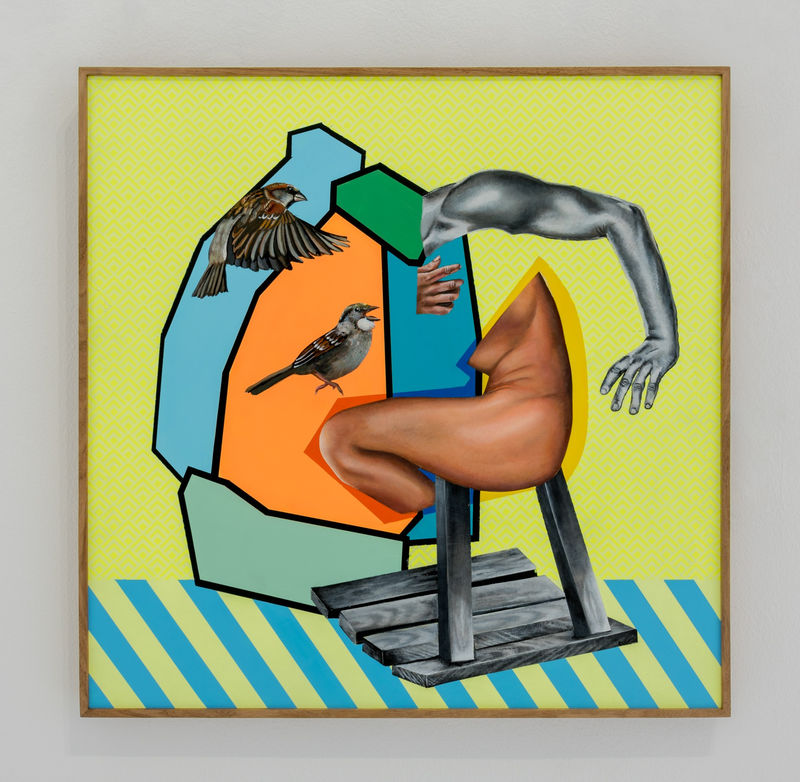
“I am attempting to find a path into painting that mines from the modernist and postmodern movements as well as integrates the immediacy of digital culture.“ The internet permeates the social climate we live in. It is through utilising internet media images and video animations that I map a trajectory towards resolving the compositions.”
Sulette van der Merwe is a South African artist based in Cape Town whose meticulously constructed paintings explore the spaces between reality and imagination, past and present, and the physical and digital worlds. Working primarily in acrylic on board, van der Merwe has developed a distinctive visual language in which figures, flowers, architectural forms, patterns and fragments drawn from contemporary visual culture are brought together within complex, dreamlike compositions.
Although her paintings frequently appear to have been assembled through collage, every element is rendered by hand. Van der Merwe deliberately cultivates this illusion, creating a tension between the apparent fragmentation of the image and the physical unity of the painted surface. Different visual languages, histories and forms coexist within a single composition, allowing seemingly unrelated images to form unexpected connections and new narratives.
Central to van der Merwe's practice is the concept of heterotopia, developed by the French philosopher Michel Foucault to describe spaces in which different worlds, periods and systems of meaning can exist simultaneously. This idea closely reflects the structure of her paintings, which occupy a territory between the familiar and the imagined. Individual fragments retain traces of their original associations while becoming part of entirely new environments, creating works with layers of meaning beyond what is immediately apparent.
Her approach to art history is also informed by the German cultural theorist Aby Warburg and his fascination with the way images, gestures and symbols migrate through time and reappear in altered forms. Rather than treating art history as a fixed sequence of movements, van der Merwe draws upon it as a living archive. Historical imagery is removed from its original context and brought into dialogue with contemporary forms, allowing the past to collide with the present and acquire new meaning.
Pop Art, Surrealism and digital culture similarly inform her practice. Van der Merwe is particularly interested in the narrative possibilities that emerge when imagery from disparate sources, including photography, illustration and the internet, is combined. The immediacy and ephemerality of contemporary image culture is translated through the slow, deliberate act of painting, establishing a recurring dialogue between the fleeting nature of the screen and the permanence of the painted object.
Movement is an equally important element within her work. Lines, fabrics, gestures and figures carry the eye through the composition, establishing visual pathways between otherwise distant images and ideas. This sense of transition extends beyond the individual elements of the paintings themselves: van der Merwe's works become psychological and imaginative spaces through which the viewer is invited to move, continually crossing between different times, references and states of perception.
Through this combination of meticulous painting, conceptual enquiry and playful visual association, van der Merwe creates worlds that resist straightforward interpretation. Her paintings function as thresholds in themselves, spaces in which histories, images and experiences overlap, and where the boundaries between reality and imagination remain deliberately fluid.

-

Sulette van der Merwe | Threshold
7 Piccadilly Arcade 11 Sep - 3 Oct 2026Taking its title from the idea of the threshold as a point of transition: an architectural boundary between one space and another, but also a place of psychological and imaginative...Read more -
The Emergent and the Iconic | Gallery Artists
7 Piccadilly Arcade 21 Aug - 28 Sep 2025The Emergent and the Iconic brings together two distinct yet interconnected forces in contemporary art: the established mastery of internationally celebrated artists and the compelling, often unpredictable, vitality of a...Read more

